If you’re in the business of supplying substation structures, you already know that location is everything. But if you’ve ever worked with projects in coastal regions, plains, or hurricane-prone zones, you’ve probably learned the hard way that wind speed isn’t just a number on a specification sheet—it’s the single biggest factor that can make or break the longevity, safety, and functionality of every steel lattice, pole, and platform you deliver. Over 12 years working as a substation structures supplier, I’ve seen structures go from code-compliant to failed in a single storm, and I’ve helped clients adapt designs that keep assets and teams safe when the wind picks up. Today, I’m breaking down the non-negotiable requirements that substation structures in high-wind areas need, and what you as a buyer should look for when choosing a partner to deliver them. Substation Structures

First, let’s ground this in what “high wind speed” actually means for substations. The International Electrotechnical Commission (IEC) defines high wind speeds as any sustained wind velocity over 110 km/h (68 mph), but for coastal areas along the U.S. Gulf or Atlantic Coasts, parts of the Mediterranean, or cyclone-prone regions of Southeast Asia and Oceania, that number can jump to 180 km/h (112 mph) or more—with gusts that push 200 km/h (124 mph). Substations are not your average commercial buildings: they hold heavy, sensitive equipment—transformers, busbars, switchgear, and circuit breakers—mounted on structures that are often 10 to 40 meters tall. That means wind doesn’t just push on the structure itself; it creates lift and drag that can shift entire equipment assemblies, damage insulators, or even topple the structure if not engineered right.
The first critical requirement is wind load design that goes beyond minimum code standards. Too many suppliers rely on basic IEC 60865 or National Electrical Safety Code (NESC) default values for wind loads, but those defaults are for average conditions, not extreme wind events. For high-wind zones, you need a site-specific wind load analysis. I’ve worked on projects in Corpus Christi, Texas, where a site-specific study revealed that gusts amplified by the close proximity of offshore oil rigs created 25% higher wind pressures than the NESC’s regional default. That meant adjusting the member size of the steel lattice from 100 mm to 125 mm, and adding diagonal bracing every meter instead of every 1.5 meters. It’s not just about picking thicker steel—it’s about accounting for factors like terrain roughness (flat plains have faster wind speeds than wooded areas), nearby obstructions (buildings or hills that can create wind shadows or turbulence), and even the height of the structure itself. Wind speed increases with altitude, so a 40-meter substation structure will experience 15-20% higher wind load than a 10-meter one in the same zone. Any supplier that skips this site-specific analysis is cutting corners—period.
Next, structural integrity for both static and dynamic wind forces. High winds don’t apply steady force; they create dynamic loads that cause vibration and sway in the structure. For substation structures, this isn’t just a comfort issue—it’s a reliability issue. If a structure sways more than a few centimeters, it can pull busbars out of alignment, crack insulators, or loosen connections that are critical for electrical continuity. For example, during Hurricane Ike in 2008, a substation in Galveston with undersized bracing experienced 12 cm of sway, leading to a 3-day outage that cost the local utility over $2 million. To prevent that, structures in high-wind areas need two key features: first, modular bracing systems that resist both lateral and torsional (twisting) forces. Lattice structures, which are the most common for large substations, work because their diagonal bracing distributes wind load evenly across every member. But for extra-high wind zones, solid steel poles might not be enough—they can twist under gusts, leading to metal fatigue over time. That’s why I often recommend hybrid structures: lattice lower sections for ground stability, solid upper sections for mounting equipment, with cross-bracing reinforced with high-tensile steel. Second, foundation design that’s engineered for wind uplift and overturning. Wind doesn’t just push sideways—it can lift a structure right out of the ground, especially if it’s near the coast where soil is sandy or soft. A standard shallow foundation might work for a low-wind zone, but in high-wind areas, you need deep-pile foundations (1.5 to 2 meters deep, depending on soil type) or mat foundations that are anchored with steel rebar and concrete mix designed to resist uplift forces. I once had a client in the Florida Keys who tried to cut foundation costs with a shallow mat; during a category 1 storm, two 30-meter structures lifted 10 cm off the ground before the utility had to emergency reinforce them. That mistake cost three times what proper foundations would have, so it’s a non-negotiable.
Third, corrosion resistance paired with wind durability. This one is often overlooked, but it’s make-or-break in high-wind areas, especially coastal ones. Wind in coastal regions carries salt spray, which corrodes steel over time—corrosion that weakens members and makes them more susceptible to wind damage during storms. You can’t just paint a structure and call it done; you need a corrosion protection system tailored to both wind and salt exposure. For most high-wind substations, hot-dip galvanizing is the minimum, but in extreme coastal zones (like the Arabian Gulf or Hawaii), we use a dual-coat system: first a zinc-rich primer, then a polyurethane topcoat that’s rated for salt spray resistance for at least 20 years. But here’s the catch: the galvanizing and coating process has to be done before the structure is assembled, not on-site. On-site painting is uneven, misses hard-to-reach corners of lattice members, and can be scratched during assembly—creating weak points where salt spray can seep in. Last year, a client in Miami received a structure that was painted on-site, and within three years, corrosion had eaten through a diagonal brace; during a minor storm, that brace snapped, taking out a section of busbar. It’s also important to specify fasteners that are corrosion-resistant too—stainless steel or hot-dip galvanized bolts, not regular carbon steel. Even a small, corroded bolt can fail during high winds, leading to a cascading failure of the structure.
Fourth, equipment mounting compatibility that accounts for wind-induced movement. Substation structures aren’t just empty frames—they hold transformers, circuit breakers, and busbars, all of which are heavy and sensitive to movement from wind. So the structure has to be designed to accommodate equipment mounts that can handle both the weight and wind forces on the equipment itself. For example, a 50-ton transformer mounted 30 meters high will experience wind pressure of over 10 kN (kilonewtons) from a 180 km/h wind, in addition to its static weight. That means the mounting bracket has to be bolted directly to the structure’s main vertical members, not just welded to secondary bracing, and equipped with vibration dampers to reduce sway. I’ve seen suppliers use generic mounting systems designed for average wind zones, which led to transformer connections breaking during a wind event in Louisiana in 2020. It’s also important to account for busbar expansion—high winds can cause the structure to sway, which puts stress on busbars that are connected rigidly. That’s why we specify flexible busbar connectors for all equipment in high-wind zones, which can absorb small movements without breaking.
Fifth, compliance with both regional and international extreme wind standards. This might sound obvious, but not all standards are created equal. The European Union’s EN 50341 standard for overhead line structures has specific provisions for extreme wind events, including a 50-year return period for wind loads in most zones, while the NESC in the U.S. uses a 10-year return period for default calculations. That means a structure that meets NESC minimums might not be strong enough for a EU project in a coastal zone. For cyclone-prone regions, the Australian Standard AS/NZS 7000 is the gold standard, which accounts for category 4 and 5 cyclone winds (up to 280 km/h). A reputable substation structures supplier will not just say “we meet code”—they will tell you which specific standard, and which return period, their design is based on. We always include a note in our proposals that structures are designed to a 100-year return period for wind loads, because substation assets have a lifespan of 40-50 years, and waiting for a 50-year wind event to test your design is a risky bet.
Now, let’s talk about what this means for you as someone purchasing substation structures. Don’t just go with the lowest bidder. I’ve seen projects where a supplier quoted 15% less because they cut corners on wind load analysis, used thinner steel, or did on-site painting. The short-term savings end up costing you way more in repairs, outages, and replacement costs. Look for suppliers who have a track record of working in high-wind zones—ask for references from utilities in coastal or cyclone regions, and ask to see the wind analysis and foundation calculations for past projects. A good supplier will also work with your engineering team to adjust designs if your site has unique conditions—like a substation built on a bluff where wind is amplified, or near a wetland with soft soil. We often tweak lattice member sizes or add extra bracing after a site visit, because no two high-wind locations are exactly the same.
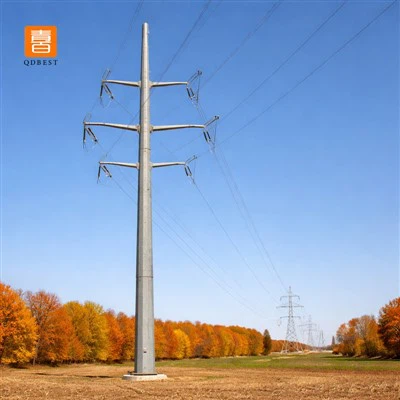
At the end of the day, substation structures in high-wind areas aren’t just steel frames—they’re critical infrastructure that keeps power flowing when people need it most. A well-designed, durable structure doesn’t just survive a storm; it protects expensive equipment, avoids costly outages, and keeps lineworkers safe during inspections and repairs. If you’re planning a project in a high-wind zone and need a supplier that understands the unique requirements of these structures, I encourage you to reach out to discuss your specific needs. We can conduct a site-specific assessment, share our past project references, and work with your team to design a structure that meets all the necessary wind load, structural, and corrosion requirements for your location.
Guyed Wire Tower References
- International Electrotechnical Commission (IEC). 2019. IEC 60865: Loads for Electrical Overhead Lines. Geneva, Switzerland: IEC.
- National Electrical Safety Code (NESC). 2022. Part 2: Substation Requirements. New York, NY: Institute of Electrical and Electronics Engineers.
- Australian Standard AS/NZS 7000:2020. Overhead Line Structures. Sydney, Australia: Standards Australia.
- American Galvanizers Association. 2021. Corrosion Protection for Steel Structures in Coastal Environments. Centennial, CO: AGA.
- Federal Emergency Management Agency (FEMA). 2018. Design Guidance for Substation Structures in High Wind Zones. Washington, DC: FEMA.
Qingdao BEST Steel Structure Co., Ltd.
Qingdao BEST Steel Structure Co., Ltd. is one of the most professional substation structures manufacturers and suppliers in China. We warmly welcome you to buy customized substation structures made in China here from our factory. If you have any enquiry about OEM service, please feel free to email us.
Address: Jiaobei Industrial Park, Qingdao, China
E-mail: sales@qdbsstower.com
WebSite: https://www.qdbsstower.com/
